✈️ Free Express Shipping to USA via JapanPost EMS | 100% Guaranteed Authentic from Tokyo

Three Details That Can Help You Recognize a Vintage Chanel Handbag

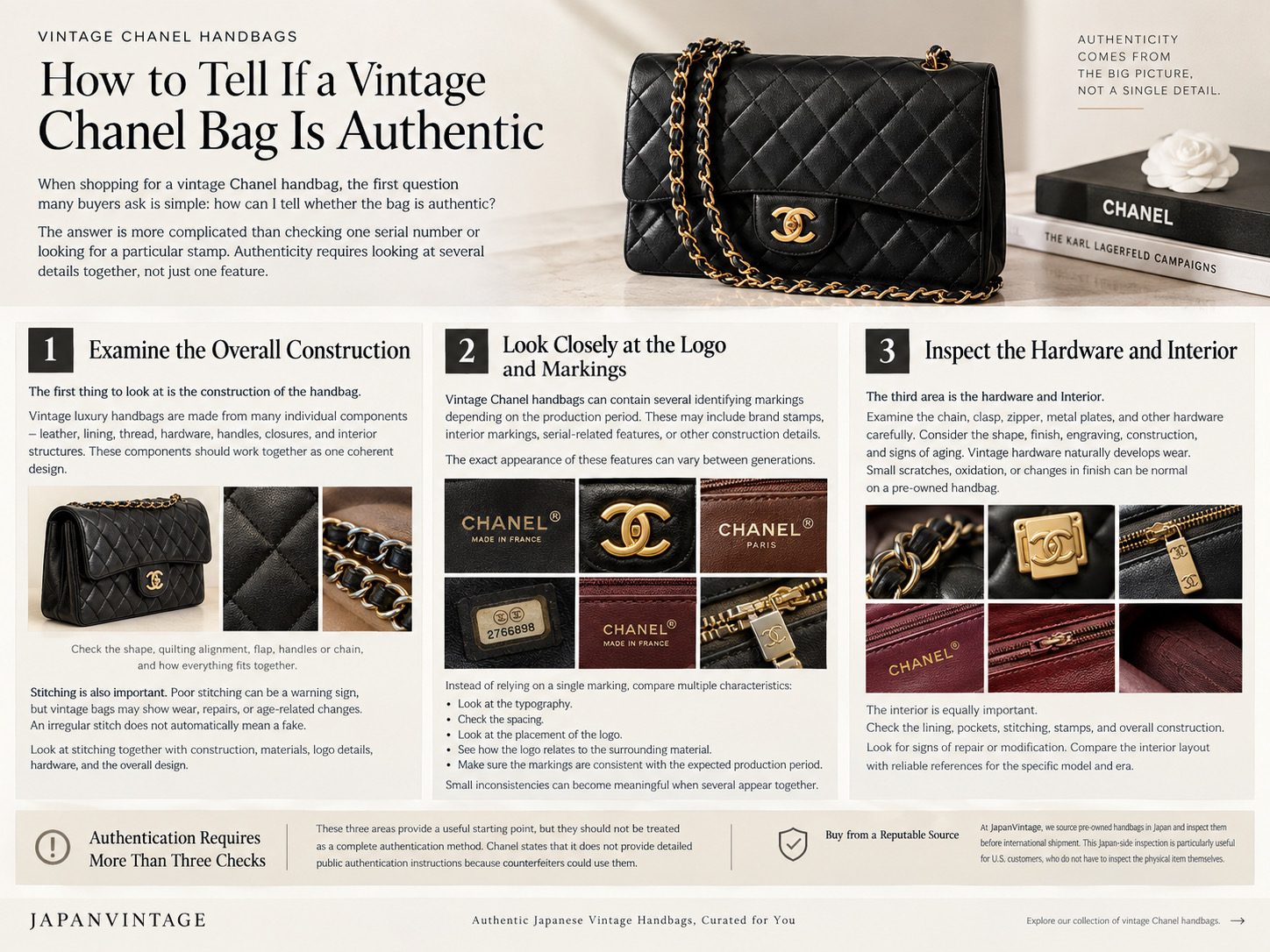
When shopping for a vintage Chanel handbag, the first question many buyers ask is simple: how can I tell whether the bag is authentic?
The answer is more complicated than checking one serial number or looking for a particular stamp. Vintage Chanel handbags have changed considerably over the years, and details can vary according to the production period, model, material, and construction.
For that reason, authentication should always involve several details together rather than relying on one feature. Chanel itself advises consumers to be cautious about unusually low prices and notes that poor stitching, misspellings, and mistakes in logos can be warning signs of counterfeit products.
If you are exploring the world of vintage Chanel, here are three areas worth examining closely.
1. Examine the Overall Construction
The first thing to look at is the construction of the handbag.
Vintage luxury handbags are made from many individual components, including leather, lining, thread, hardware, handles, closures, and interior structures. These components should work together as one coherent design.
Pay attention to the shape of the bag. Does it hold the expected silhouette for that particular Chanel model? Are the quilting patterns aligned appropriately? Does the flap sit naturally? Are the handles or chain positioned as expected?
Stitching is another important area.
Chanel’s own anti-counterfeit guidance specifically mentions poor stitching as one possible indication of a counterfeit. However, stitching should not be examined in isolation. Vintage bags may show wear, repairs, or changes caused by age, so an irregular-looking stitch does not automatically mean a bag is fake.
The better approach is to consider stitching together with construction, materials, logo details, hardware, and the overall design.
2. Look Closely at the Logo and Markings
The second area is the branding.
Vintage Chanel handbags can contain several identifying markings depending on their production period. These may include brand stamps, interior markings, serial-related features on older examples, or other construction details.
The exact appearance of these features can vary between generations.
This is why online authentication guides that provide one universal rule can be misleading. A detail that applies to one generation of Chanel may not apply to another.
Instead of asking whether a single marking “looks right,” compare multiple characteristics.
Look at the typography.
Look at spacing.
Look at the placement of the logo.
Look at how the logo relates to the surrounding material.
Look at whether the markings are consistent with the expected production period.
Small inconsistencies can become meaningful when several appear together.
3. Inspect the Hardware and Interior
The third area is the hardware and interior.
Examine the chain, clasp, zipper, metal plates, and other hardware carefully. Consider the shape, finish, engraving, construction, and signs of aging.
Vintage hardware naturally develops wear. Small scratches, oxidation, or changes in finish can be normal on a pre-owned handbag. In fact, the presence of wear should not automatically be treated as evidence against authenticity.
The interior is equally important.
Check the lining, pockets, stitching, stamps, and overall construction. Look for signs of repair or modification. Compare the interior layout with reliable references for the specific model and era.
Authentication Requires More Than Three Checks
These three areas provide a useful starting point, but they should not be treated as a complete authentication method.
Chanel states that it does not provide detailed public authentication instructions because counterfeiters could use them. The safest approach is therefore to purchase through a reputable source and have the item examined using multiple characteristics.
At JapanVintage, our approach is to source pre-owned handbags in Japan and inspect them before they are prepared for international shipment. For customers purchasing from the United States, this additional Japan-side inspection is particularly useful because the customer does not have to inspect the physical handbag personally before purchase.
If you are searching for a pre-owned Chanel piece, explore our collection of vintage Chanel handbags.
A vintage Chanel handbag should be appreciated not only for its logo, but also for its construction, materials, history, and condition. Learning what to examine can make the buying process much more informed and enjoyable.