✈️ Free Express Shipping to USA via JapanPost EMS | 100% Guaranteed Authentic from Tokyo

Why Pre-Owned Luxury Goods From Japan Are Known for Good Condition

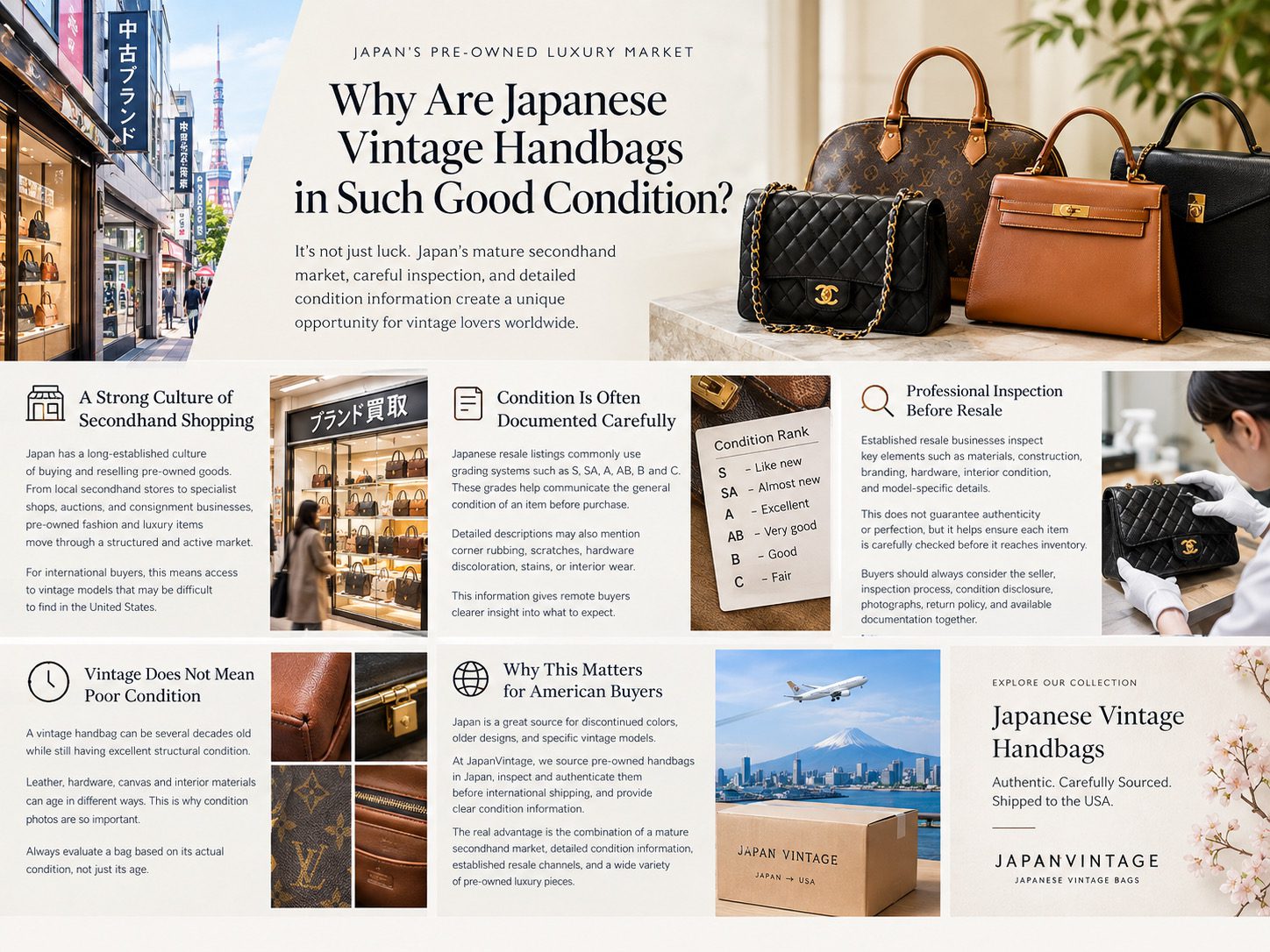
When American shoppers first discover Japan’s pre-owned luxury market, one question often comes up: why do so many vintage handbags from Japan appear to be in such good condition?
There is no single reason.
Japan has developed a large and sophisticated secondhand market where pre-owned fashion, watches, jewelry, and luxury accessories are routinely inspected, categorized, priced, and resold.
For vintage handbag buyers, this creates an interesting opportunity. A handbag that has been owned for years does not necessarily have to look heavily worn.
A Strong Culture of Secondhand Shopping
Japan has a long-established culture of buying and reselling pre-owned goods.
Secondhand stores are common in many Japanese cities, while specialist businesses focus specifically on luxury handbags, watches, jewelry, and designer fashion.
This creates an active circulation of pre-owned products.
Instead of remaining unused in someone’s closet indefinitely, handbags can move through a structured resale market. Sellers can bring unwanted items to professional resale stores, consignment businesses, auctions, and other channels.
For international buyers, this means Japan can provide access to vintage models that may be difficult to find in the United States.
Condition Is Often Documented Carefully
One particularly useful characteristic of Japanese resale listings is the use of condition grades.
Different businesses can use slightly different grading systems, so buyers should always check the specific seller’s definitions. However, Japanese resale listings commonly distinguish between categories such as S, SA, A, AB, B, and C.
These grades are intended to communicate the general condition of an item before purchase.
A detailed condition description may also mention specific issues such as corner rubbing, scratches, hardware discoloration, stains, or interior wear.
For a remote buyer, this information is valuable.
Instead of simply seeing a phrase such as “good condition,” a customer can look for specific information about the areas that matter most.
Professional Inspection Before Resale
Another reason Japanese pre-owned luxury goods can have a strong reputation is the inspection process used by established resale businesses.
The exact procedure varies from company to company. There is no single universal Japanese authentication procedure that applies to every auction or retailer.
However, specialist businesses commonly inspect important elements of luxury handbags before placing them into inventory.
These may include materials, construction, branding, hardware, interior condition, and model-specific characteristics.
This does not mean every item sold in Japan is automatically authentic or perfect.
That distinction is important.
Japan’s reputation should not replace proper authentication. Instead, buyers should consider the seller, inspection process, condition disclosure, photographs, return policy, and available documentation together.
Vintage Does Not Mean Poor Condition
A vintage handbag may be several decades old while still having excellent structural condition.
Leather can age differently depending on how the handbag was stored. Hardware can develop natural signs of use. Canvas can remain remarkably well preserved. Interior materials may show more wear than the exterior.
This is one reason condition photographs are so important.
A vintage handbag should be evaluated according to its actual condition rather than its age alone.
An older bag with carefully maintained leather, clean interior, and limited hardware wear may be more appealing to some buyers than a newer bag that has experienced heavy use.
Why This Matters for American Buyers
Buying from Japan can be especially interesting for customers in the United States who are looking for discontinued colors, older designs, or specific vintage models.
At JapanVintage, our goal is to make that Japan-to-USA process easier.
We source pre-owned handbags in Japan, inspect and authenticate them before international shipping, and provide customers with information about the item’s condition.
You can explore our selection of Japanese vintage handbags to see the types of pre-owned pieces available from Japan.
The appeal of Japanese vintage is therefore not simply that “Japanese bags are better.”
The real advantage is the combination of a mature secondhand market, detailed condition information, established resale channels, and access to a wide variety of pre-owned luxury pieces.
For someone shopping for vintage fashion, that combination can make Japan a particularly interesting sourcing destination.